
To all our highly valued clients and acquaintances:
What happens when a bird tries to fly with only one wing?
It may flap fiercely. It may make noise. It may insist its wing is the most important one.
But it will not fly very far.
That image has stayed with me lately—especially as so many relationships, workplaces, communities, and public conversations seem pulled toward “us versus them.”
So here is this month’s question:
In a difficult situation, is it possible not to take sides—but instead to be for all sides?
Not in the sense of avoiding truth.
Not in the sense of pretending all views are equally wise or helpful.
But in the deeper sense of recognizing that no one person, group, or perspective usually holds the entire picture.
Perhaps the Universe wants the whole bird: different wings working together, in balance, toward a shared destination.
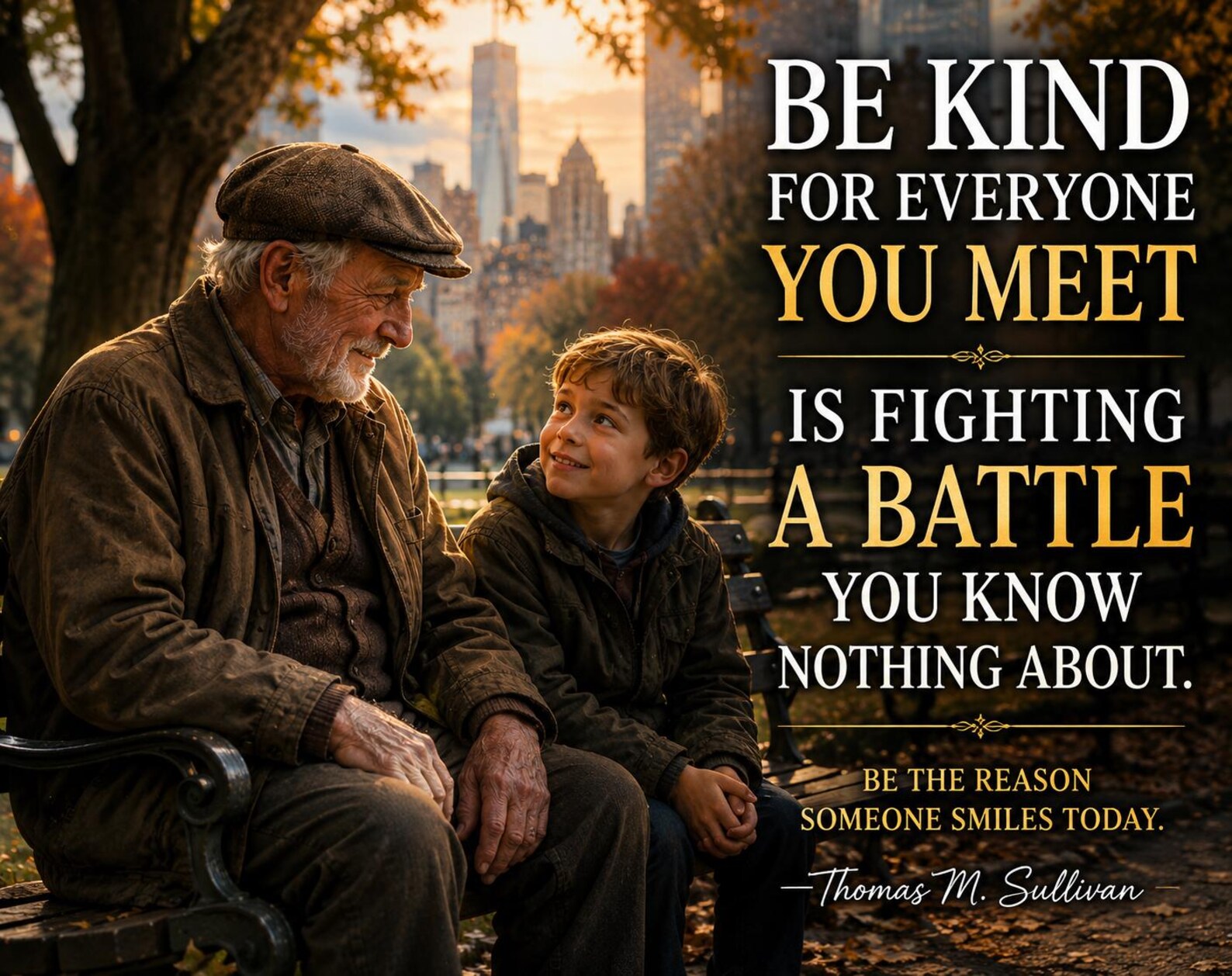
“Be kind, for everyone you meet is fighting a battle.”
This widely shared thought is most accurately traced to Scottish author and minister Ian MacLaren, the pen name of Reverend John Watson, writing in 1897.
It is a simple reminder with enormous implications: the person across from us may be carrying a struggle we cannot see.
The Elephant in the Room
You may know the ancient parable of the blind men and the elephant.
One touches the trunk and says, “An elephant is like a snake.”
Another feels a tusk and says, “No – it is like a spear.”
Another touches the side and insists, “You are both wrong. It is like a wall.”
Each person is partly right.
And each person is incomplete.
That is the challenge for all of us today. Our perspective may be real, valid, and shaped by genuine experience. But it may still be only one part of a much larger truth.
Intellectual humility begins when we can say:
“I may be seeing something important – and I may not yet be seeing the whole.”
That mindset can change a family conversation, a leadership team meeting, a client relationship, a business partnership, or a community disagreement.
Beyond “My Way” or “Your Way”
Dr. Stephen R. Covey called this possibility The 3rd Alternative.
It moves us beyond the familiar choices:
| Approach | Typical Result |
| My way | One side wins; the other feels dismissed or defeated |
| Your way | The reverse happens |
| Compromise | Each side gives up something; neither is fully satisfied |
| The 3rd Alternative | People create a new, better solution neither could have designed alone |
The 3rd Alternative is not surrender. It is not weakness. It is not simply “meeting in the middle.”
It is a creative, disciplined search for an “our way” that is genuinely better than either original position.
Covey connected this to his sixth habit: Synergize. When people bring different strengths, experiences, and viewpoints into a respectful conversation, 1+1 can become far more than 2.
It can become 10, 100, or something entirely new.
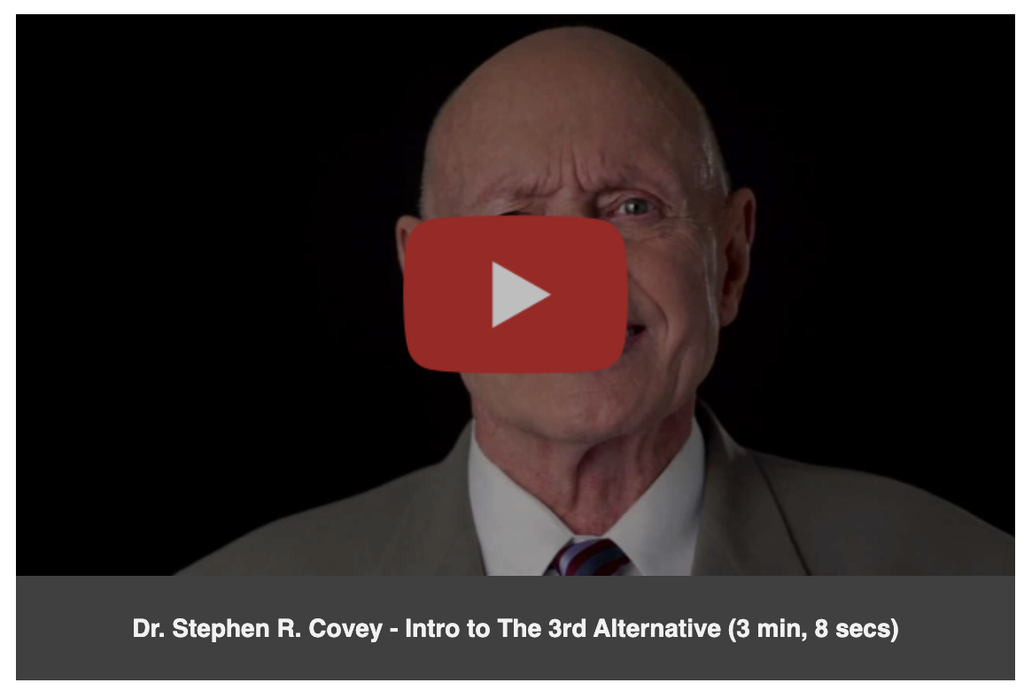
Again, if you would like a concise introduction, here is Dr. Covey’s short video:
Dr. Stephen R. Covey: Introduction to The 3rd Alternative
About 3 minutes, 8 seconds
Four Moves Toward a Better Answer
When you find yourself stuck in a disagreement – at work, at home, or within yourself -consider trying these four moves:
- See yourself.
Step back from your own certainty, ego, fear, or entrenched position. Ask: What might I be missing? - See the other person.
Look beyond labels, assumptions, and reactions. Ask: What matters to them? What are they trying to protect, preserve, or achieve? - Seek them out.
Listen to understand – not merely to prepare your response. Ask questions that invite truth rather than defensiveness. - Synergize.
Ask: Is there a better answer than either of us has seen so far? What could we create together?
One powerful question can open a door:
“Would you be willing to look with me for a solution that is better than either of our original ideas?”
That question does not guarantee agreement. But it can transform the quality of the conversation.
It Is a Long Road to Freedom
The song It’s a Long Road to Freedom, written by Sister Miriam Therese Winter and recorded by the Medical Mission Sisters in 1966, carries a message that feels especially timely.
Its imagery is one of a long and demanding journey: walking at dawn, traveling beside the sea, and continuing over roads that are winding, steep, and high.
The message is not that life is easy.
The message is that love, companionship, courage, and shared purpose can make even a difficult road more bearable. When we walk with others rather than against them, hardship can be transformed. Winter can eventually become spring.
That is worth remembering.
Progress rarely happens overnight. Rome was not built in a day. The Declaration of Independence was not written in a moment of comfort or certainty. President John F. Kennedy’s commitment to land a person on the moon and return them safely was made before the necessary technology existed.
Those examples do not suggest that every aspiration will be easy. They remind us that meaningful progress often begins before the path is fully visible.
Progress, Not Perfection
I believe we have more choices, more tools, and more resources available to us than we sometimes realize.
Some answers have not yet been discovered.
Some capabilities have not yet been developed.
Some relationships have not yet been repaired.
Some opportunities have not yet been explored.
Some doors may open only after we have the courage to knock.
“Seek and you shall find” remains a worthy invitation.
Look in places you have not looked before. Ask questions you have not yet asked. Consider possibilities you may have dismissed too early.
And remember:
If it is to be, it is up to me.
Not because we must do everything alone – but because we each have responsibility for the choices, attitudes, conversations, and actions we bring into the world.
Personally, I am working to walk more softly and carry a bigger talking stick—one that asks better questions, listens more carefully, and invites more possibility.
A Question for You
Where in your life could a “whole bird” approach make a difference?
- A family relationship?
- A workplace tension?
- A leadership challenge?
- A business partnership?
- A conversation you have been avoiding?
- A personal habit, fear, or inner conflict?
And perhaps the most important question:
Are you betting on yourself – and creatively progressing in the face of your odds?
I am in the business of helping people get what they want – for their reasons.
My role is not to impose answers. It is to ask worthwhile questions, listen carefully, help people see new choices, and support them in turning good intentions into practical forward movement.
If a relationship, team, business challenge, leadership situation, or personal goal would benefit from a clearer conversation and a fresh perspective, I would be glad to talk.
What would serve you best at this point?
Feel free to contact me.
Until next time – best to you.
At your service,
Don Sardella
Business Coach
A Few Closing Thoughts
“Our task must be to free ourselves … by widening our circles of compassion to embrace all living creatures and the whole of nature in its beauty.” – Albert Einstein
“Until one extends one’s circle of compassion to all living things, humanity will not find peace.” – Albert Schweitzer
“He drew a circle that shut me out—
Heretic, rebel, a thing to flout.
But love and I had the wit to win:
We drew a circle and took him in!” – Edwin Markham